Why AI Didn't Recommend Your Business (And How to Fix It)

BoldGrow AI
5 min read · Aug 27, 2026
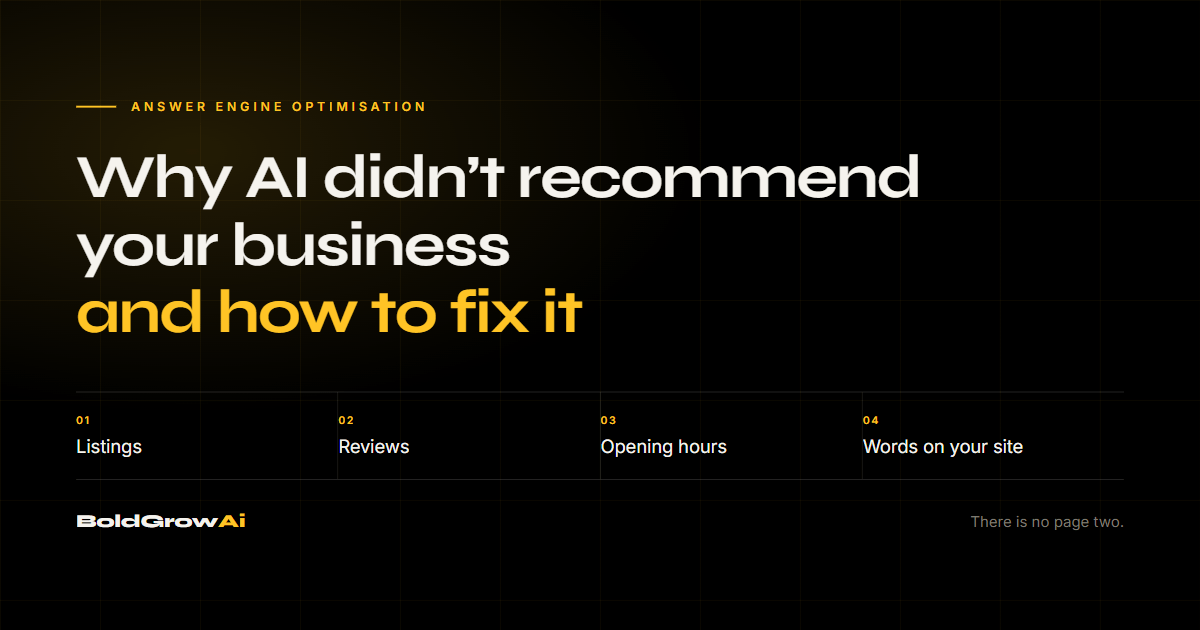
Someone asked an AI for the best business like yours nearby. It named one. If it wasn’t you, that is not a mystery and not a punishment — the AI read a handful of public facts about you, found them incomplete or contradictory, and picked a business it could be confident about instead.
Last reviewed: 27 August 2026.
For twenty years, being findable meant appearing somewhere on a list of ten blue links. If you were fourth, you still existed. If you were on page two, you were still there for anyone who looked.
That list is disappearing. A person now types “best dentist near me” into ChatGPT and gets a paragraph naming one or two businesses. There is no page two. There is one answer, and either you are in it or you are invisible for that question.
This is not a prediction. Use of ChatGPT and other generative AI tools for local recommendations rose from 6% to 45% of consumers in a single year, making it the third most popular source of business recommendations, according to BrightLocal’s Local Consumer Review Survey. Gartner separately forecasts traditional search engine volume will drop 25% by 2026 as people move to AI answer engines.
Check it yourself before you read any further. Open ChatGPT. Type “best [your trade] in [your area]”. See who it names. It takes thirty seconds and it will tell you more about your position than any report I could write.
Here is the honest version: nobody outside these companies knows how the models weigh anything. What is knowable is what they read — the public record about your business. Four things make up most of it.
Your name, address and phone number, everywhere they appear — Google Business Profile, Bing Places, Apple Business Connect, Justdial, Yelp, industry directories, your own website footer.
What to check: search your business name and open the first five listings. Is the name spelled identically in all five? The same street address, formatted the same way? The same phone number?
How many, how recent, and what they actually say. Reviews are the largest body of independent text about your business, which makes them the main thing an AI has to read that you did not write yourself.
What to check: when was your most recent review left? If the answer is “some time last year”, that is the gap to close first.
Present, current, and the same everywhere. Hours are a small thing that quietly signals whether a listing is maintained or abandoned.
What to check: are your festival and holiday hours right? Does your website footer agree with your Google listing?
Whether your site plainly states, in text, what you do and where you do it. Not in a logo. Not in a banner image. In readable words.
What to check: open your homepage and read the first paragraph. Does it name your service and your city in plain language? A site that says “Excellence. Redefined.” tells a machine nothing.
This is the single most useful thing on this page, and almost no business owner knows it.
ChatGPT’s web search runs on Microsoft Bing’s index, not Google’s. Every hour you have ever spent on your Google Business Profile has done very little for the answer ChatGPT gives about you, because ChatGPT is not reading Google.
Most owners have never opened Bing Places. It is free, it takes about fifteen minutes, and in many cases it can import your details straight from your Google listing. If you do one thing from this page, do this one.
Claim your listing at Bing Places for Business. Then check Apple Business Connect too — Apple Maps feeds Siri and a growing number of assistants.
This is the failure I see most, and it is completely invisible from the inside.
Imagine a clinic. Across the web, it is written three ways:
Sharma Dental Care, 12 MG Road, Bengaluru 560001 — 080 4123 5566Sharma Dental Clinic, 12 M.G. Rd, Bangalore 560001 — +91 80 4123 5566Dr. Sharma Dental, Shop 12, MG Road, Bengaluru — 9845012345To you, that is obviously one business. You know the shop, you know the doctor, you know the phone rings in the same room.
To a machine reading the public record, that is three weak signals instead of one strong one. Nothing there is a lie. Nothing needs correcting for accuracy. But the AI cannot confirm these are the same place, so its confidence in each is low — and when it has to name one business, it reaches for the one whose details agree with themselves everywhere.
The competitor who got named is often not better than you. They are just easier to verify.
None of this needs an agency. All of it is free apart from your time.
1. Claim Bing Places. Fifteen minutes, and it can usually import from Google. This is the highest-leverage item on the list.
2. Pick one canonical version of your name, address and phone. Write it down in a note. Exact spelling, exact abbreviations, exact phone format. This is now the only version you ever use.
3. Fix the five listings you can find. Search your business name, open the first five results, make each one match your canonical version exactly. Do not try to fix forty. Five real fixes beat forty half-fixes.
4. Ask five recent, happy customers for a review this week. Ask them in person or by message, and ask them to mention the service they had and the area. “Great service” helps you less than “quick root canal, MG Road” — because the second one contains the facts a machine is looking for.
5. Put your service and city in plain text on your homepage. One sentence, near the top, in real text. “We are a family dental clinic on MG Road, Bengaluru, open six days a week.”
6. Fill in your opening hours everywhere, including holidays. Then set a reminder to check them twice a year.
7. Add LocalBusiness schema to your website. This is a small block of code that states your facts in the format machines read first. Give this to whoever built your site — or paste it into your homepage’s <head> yourself:
<script type="application/ld+json">
{
  "@context": "https://schema.org",
  "@type": "Dentist",
  "name": "Sharma Dental Care",
  "image": "https://example.com/clinic.jpg",
  "url": "https://example.com",
  "telephone": "+918041235566",
  "address": {
    "@type": "PostalAddress",
    "streetAddress": "12 MG Road",
    "addressLocality": "Bengaluru",
    "addressRegion": "KA",
    "postalCode": "560001",
    "addressCountry": "IN"
  },
  "openingHoursSpecification": [{
    "@type": "OpeningHoursSpecification",
    "dayOfWeek": ["Monday","Tuesday","Wednesday","Thursday","Friday","Saturday"],
    "opens": "09:30",
    "closes": "19:00"
  }],
  "sameAs": [
    "https://www.facebook.com/yourpage",
    "https://www.instagram.com/yourpage"
  ]
}
</script>
Change Dentist to whatever fits — Restaurant, HealthAndBeautyBusiness, AutoRepair, Gym. The full list is on schema.org. Only ever mark up facts that are actually visible on your page.
8. Re-run the test in a month. Same question, same AI. This is the only measurement that matters, and it is free.
Answer engine optimisation (AEO) is the work of making sure the machines that answer questions can read, verify and trust the facts about your business. That is the whole definition.
It overlaps with SEO but the goal is different. SEO was largely about earning a position on a list. AEO is about being the business an answer engine is confident enough to name when there is only room for one. Confidence comes from facts that agree with each other everywhere they appear.
They overlap but they are not the same. SEO works to place you on a ranked list of results. AEO works to make your business verifiable enough that an AI will name it in a single answer. The foundations — accurate listings, real reviews, clear text on your site — serve both.
No. There is no advertising slot inside an AI’s recommendation today, and anyone selling you one is selling something else. What you can influence is whether the public facts about your business are complete, consistent and current.
Listings update in days to a few weeks depending on the platform. Reviews accumulate at whatever pace you ask for them. Realistically you are looking at four to eight weeks before a retest shows a difference, and it depends on how far off your starting point is. Anyone promising a result next week is guessing.
Usually not. Most of this checklist happens off your website entirely — on listings and review platforms. The website work is normally one paragraph of plain text and one block of schema code. If your site is genuinely broken or has no readable text at all, that is a different conversation.
Then that is your first job, and it is the most valuable one. Ask five recent customers this week. You are not trying to reach a hundred — you are trying to move from zero, because zero reviews means there is almost nothing independent for a machine to read about you.
That is rather the point. This work targets Bing, Apple Maps, and the AI tools that read them, which are precisely the places most businesses have never touched. Google remains important; it is just no longer the only door.
No, and be wary of anyone who says otherwise. Nobody outside these companies controls or fully understands how an answer is chosen. What you can do is remove every reason for a machine to be unsure about you — which is what everything above does.
I will run the same test on your business that you just ran on it — ask the AI what it says about your trade in your area, look at what it read to get there, and tell you plainly what I found.
It takes about two minutes of your time and costs nothing. You get a short written summary: what the AI named, which of the four areas above are working against you, and what to fix first. No call required, no obligation, and if you are already being named correctly I will tell you that instead of inventing a problem.
Get your free 2-minute AI audit →
If you would rather see the work first, here is what we build for businesses across India and Dubai and the sites we have made.
AI Assistant
Today at 11:32 PM
If you have any questions about BoldGrow AI - I'm here to help - ask me anything!
Monica • Just now